Logibot.Train

How a general AI model becomes a logistics robot

Most robotics teams fine-tune a model once and deploy. Logibot.Train takes a different approach: 5 stages that progressively transform a general vision-language model into a high-performance logistics robot.
Discuss your use case
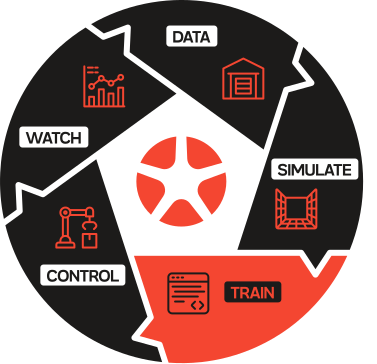
How training fits into the Logibot platform

Why training matters

When variability increases, a model that was fine-tuned once degrades with no recovery path. Competence has to be built layer by layer, from semantic understanding of objects and instructions, to physical action, to KPI-aligned reinforcement learning.

Not a configuration. A construction process.
What Logibot.Train delivers

The output is not a configured robot. It is a robot that has built competence layer by layer: from understanding what a parcel is and what "stack" means, to knowing how to grasp it physically, to executing that grasp reliably across thousands of cycles at industrial throughput.

Each stage gates the next. Nothing is deployed until the final layer passes performance thresholds on your tasks, in your environment, against your KPIs.

Predictable execution under real operational conditions, not just in a pilot.
How Logibot.Train works

1. General Knowledge Backbone

Semantic intelligence as the foundation

The process starts with a foundation Vision-Language Model pre-trained on web-scale data. It already understands what a parcel is, what "stack" or "avoid collision" means, and how objects relate in space. It has no motor control capability yet, but it has the semantic reasoning that makes everything else possible.

2. Multimodal Reasoning & Grounding

Connecting language to visual reality

The model learns to connect what it reads to what it sees. A task description like "place parcel in chute 3" becomes a structured internal representation linked to a real visual scene. The model can now reason about what it needs to do before it does anything.

3. General Robotics Pretraining

First contact with the physical world

This is the first embodiment-aware stage. The model learns how objects can be grasped, how forces work in contact, how motion should be planned across a sequence of actions. It develops intuitions about what is physically feasible before being placed in any specific robot or environment.

4. Effective Tuning

Turning capacity into competence

This is where most robotics teams fail. Large-scale pretraining gives the model raw capability, but not operational reliability. This stage shapes that capability into task-specific competence: the right behavior for your robot, your environment, your edge cases. It is entirely technique-driven and specific to your deployment context.

5. RL Alignment

Optimized for industrial performance

Behavior cloning has limits in long-horizon tasks and contact-rich manipulation. The final stage applies reinforcement learning to push performance beyond what imitation alone can achieve, with rewards aligned to your actual KPIs: cycle time, success rate, throughput per shift.

Next steps

Discuss your intralogistics challenge
See how Logibot.Control brings trained robots into operations →